
Skip to content

Ankylosing Spondylitis (AS)

Ankylosing Spondylitis (AS)

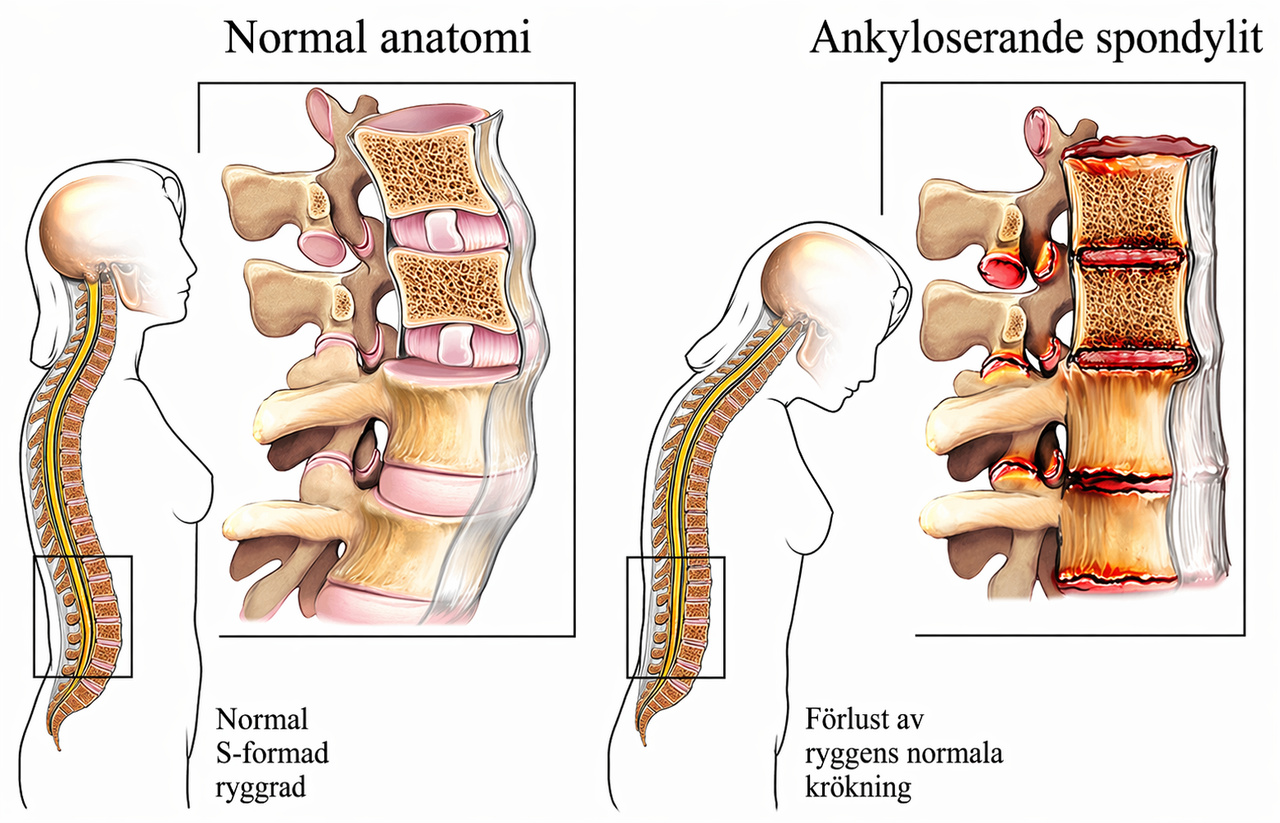
Ankylosing spondylitis is a chronic inflammatory back disease that primarily affects the spine and pelvic joints.

Quick version

What is Ankylosing Spondylitis?

Ankylosing spondylitis is an autoimmune disease where the body's immune system attacks the areas where tendons and ligaments meet bone, especially in the spine and sacroiliac joints. The name comes from the Greek "ankylos" (stiff/fused) and "spondylos" (vertebra). Long-term inflammation can lead to new bone formation, causing vertebrae to fuse and the spine to become rigid. It usually debuts in young adulthood, typically before age 40.

How does Ankylosing Spondylitis feel?

Symptoms often develop gradually and differ from mechanical back pain by improving with activity. Common symptoms include:

  • Gradual back pain: Pain in the lower back and buttocks lasting more than three months.
  • Morning stiffness: Pronounced stiffness in the morning often lasting over 30 minutes.
  • Nocturnal pain: Pain that wakes the person late at night but eases upon getting up and moving.
  • Improvement with movement: Unlike a common back strain, AS pain gets better with exercise and worse with rest.
  • Other inflammations: Heel pain (enthesitis), inflammation in large joints (knees/shoulders), or eye inflammation (uveitis).
  • Fatigue: A general feeling of tiredness caused by ongoing inflammation.

Why do people get Ankylosing Spondylitis?

The exact cause is unknown, but research points to a combination of genetics and environmental factors:

  • Genetics (HLA-B27): The strongest risk factor. Most people with AS carry the HLA-B27 gene, though not everyone with the gene develops the disease.
  • Immune system: An imbalance causes the immune system to attack the body's own tissues.
  • Gut flora: Studies suggest changes in gut bacteria may play a role in triggering inflammation.
  • Gender: The disease is slightly more common in men, though it may be underdiagnosed in women due to differing symptoms.

How is Ankylosing Spondylitis diagnosed?

Diagnosis can take time as back pain is very common. The investigation includes:

  • Medical history: Looking for inflammatory back pain patterns (onset before 40, improvement with movement).
  • Blood tests: Checking ESR and CRP for signs of inflammation and testing for the HLA-B27 gene.
  • MRI: The most sensitive tool for detecting early signs of inflammation in the sacroiliac joints.
  • X-ray: Can show advanced changes or bone fusion after long-term disease.
  • Physical tests: Assessing spinal mobility and chest expansion.

Questions and answers

Unlike mechanical back pain, AS symptoms typically improve with exercise and movement rather than rest. It is also distinguished by significant morning stiffness lasting more than 30 minutes and pain that wakes the person up during the late night or early morning.

Common symptoms include persistent lower back and buttock pain lasting over three months, morning stiffness, nighttime pain that eases upon getting up, and general fatigue caused by the ongoing inflammation in the body.

Yes, there is a strong genetic link. Most people affected carry the HLA-B27 genetic marker. However, it is important to note that not everyone who has the gene develops the disease; it often requires a combination of genetics and environmental factors.

Related tests and health checks


MRI Lumbar spine

MRI Lumbar spine

MRI of the lumbar spine
Information

Medical comment included

With us, you will always receive a doctor’s opinion from a licensed physician when you order a medical check-up that includes a medical opinion. The doctor’s opinion includes an overall assessment of your results from laboratory analysis. The opinion is individual and may vary depending on the specific tests your medical check-up includes.

What can I expect in the medical report?

The medical opinion will summarize the results of your test results to give you an assessment of your health including any abnormalities outside the reference ranges. In case of abnormalities or need, your doctor may also contact you for a free conversation to explain and talk about your results. Remember that a health check always includes specific test results based on your health and your personal circumstances. Values outside the reference range should therefore always be discussed with a doctor before any decisions regarding possible treatment are made.

What does the doctor look at during a health check?

When assessing a blood test or health check, your doctor will look at several different parameters to evaluate your health and identify any abnormalities. Below are some common aspects your doctor may examine:

Blood counts: Your doctor will check red, white and platelet counts to identify any signs of anaemia, infection or bleeding.

Nutrients and biochemical markers: Includes, for example, analysis and monitoring of blood sugar (glucose) levels, electrolyte levels (e.g. sodium, potassium), liver function tests (e.g. liver enzymes), kidney function tests (e.g. creatinine, urea) and lipid profile (e.g. cholesterol, triglycerides). The results of the tests give your doctor a better idea of your organ function, blood sugar level, cholesterol conditions and other important health aspects.

Inflammatory markers: Your doctor may measure health markers such as C-reactive protein (CRP) or red blood cell decrease rate (SR) to evaluate inflammatory conditions or confirm an active infection.

Hormone levels: Your doctor may monitor your hormone levels to assess hormonal imbalances or diseases, such as thyroid hormones (TSH, T3, T4), sex hormones or other specific hormones such as testosterone levels.

Specific tests: Depending on your goal of your health check or medical history, your doctor may look into specific tests to investigate conditions or diseases, such as diabetes, vitamin deficiency or autoimmune diseases.

In conclusion, the doctor weighs all test results based on the health check to assess your overall health, detect any abnormalities and identify possible underlying medical conditions.

What happens if I have abnormal test results?

If your blood count is abnormal, this will be addressed in your personal medical opinion. Depending on the nature and extent of the abnormality, your doctor may also contact you directly through the test result service for further guidance. Various measures and advice will be provided based on the specific abnormalities observed along with your medical history.

Call included

Call included, one of our doctors will contact you.
  • MRI of the lumbar spine shows vertebrae, discs, nerves and facet joints in detail.
  • Recommended for back pain, sciatica or nerve damage.
  • MRI provides sharp images – completely without radiation.
  • Referral and specialist opinion included.

5 995 kr

Other symptoms

Cart

The basket is empty.

Hos oss får du tillgång till Sveriges bredaste utbud av blodprov, hälsokontroller och MR – med läkare som alltid granskar dina provsvar.

Select tests


Sampling fee
Total
Sampling fee?

The sample collection fee is a fixed cost that refers to the visit to the clinic where you submit your sample. The fee is not affected by how many tests you have ordered, but varies depending on the order value:

Free sampling fee

For purchases over 1 000 SEK, the sampling fee is included.