Quick version
Most tick bites do not lead to Lyme disease. The risk of infection after a single tick bite is low, and if you feel well and only develop a small rash that disappears quickly, you usually do not need to seek medical attention or get tested.
The most important thing is to monitor your skin over the following weeks. Seek medical attention if you develop a rash that continues to expand, especially if it grows larger than about five centimetres (two inches) in diameter, or if you experience fever, headache, nerve pain, numbness, facial paralysis, or joint swelling. Lyme disease can usually be treated effectively with antibiotics when diagnosed early.
Remove ticks as soon as you notice them, check your skin after spending time in forests, tall grass, or dense vegetation, and remember that Lyme disease cannot currently be prevented with a vaccine, unlike TBE.
After a walk in tall grass or a weekend at the summer cottage, it's easy to get caught up in the idea that every tick bite means Lyme disease. Fortunately, that's not the case. Lyme disease is common in Sweden, but the risk of getting sick after a single tick bite is low, and most bites never lead to any infection.
Lyme disease and tick bites – when should you be concerned?
Lyme disease is a bacterial infection that is spread by ticks. In Sweden, the disease occurs throughout the country, and it is one of the most common tick-borne infections. At the same time, the message is reassuring: even though many Swedes get Lyme disease every year, most people who are bitten never get sick.
The Public Health Agency states that the risk of Lyme disease infection after a tick bite is around 2–3 percent. One explanation is that the bacteria are not usually transmitted immediately when a tick bites, but usually only after a longer period of attachment. Therefore, rapid detection and early removal likely further reduce the risk.
For those who live near forests, have children who play in wooded areas, or work outdoors, the question often becomes practical: when should you just wash your skin and move on, and when should you seek medical attention? It is mainly determined by the appearance and time course of the symptoms, not by the bite itself.
The doctor on when you should seek care
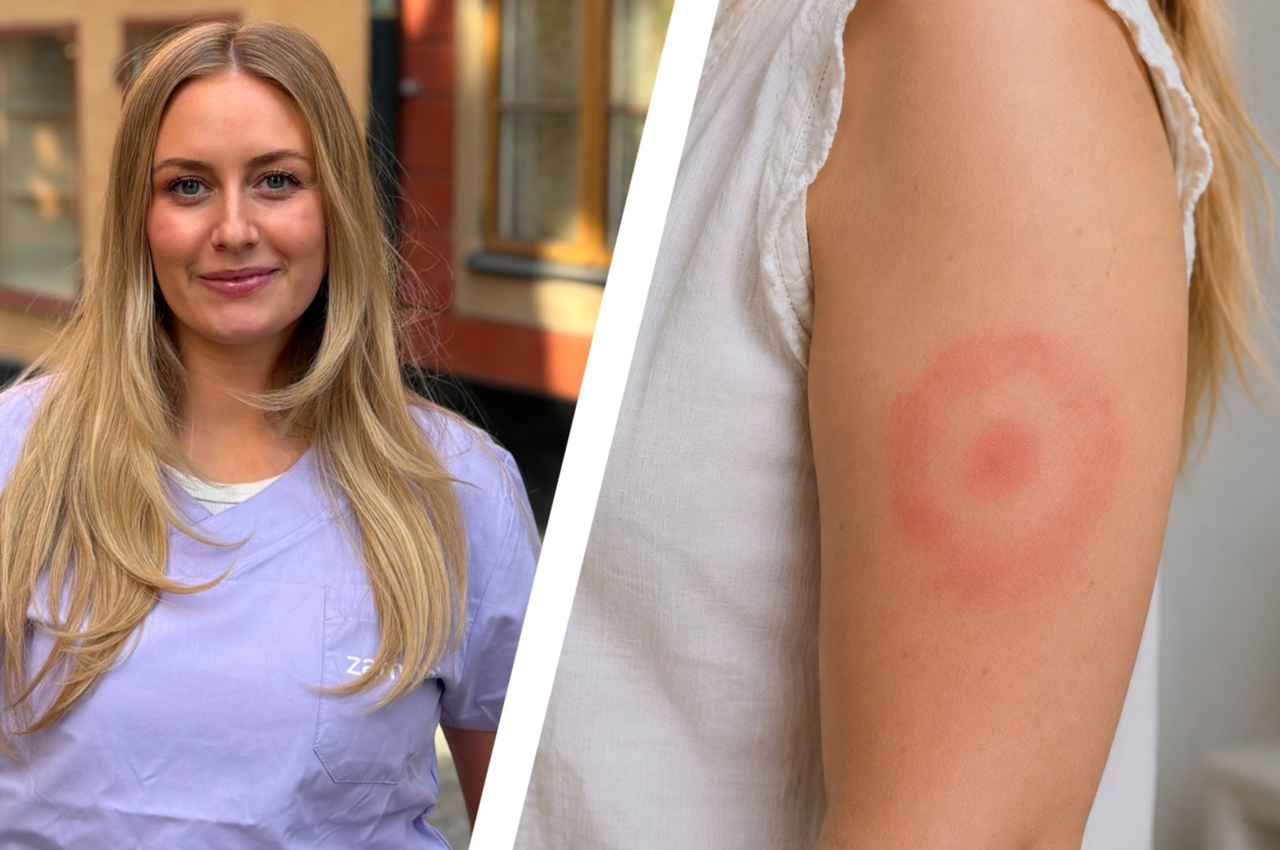
– Hannah Krantz, doctor at Testmottagningen
How common is Lyme disease in Sweden?
Since Sweden lacks a national surveillance program for Lyme disease, the exact annual figures vary. However, the disease is estimated to affect several thousand Swedes each year.
There is an important difference between Lyme disease and TBE. Lyme disease is caused by bacteria and can be treated with antibiotics when the diagnosis is clear. TBE is caused by a virus and can be prevented with a vaccine, but there is no vaccine against Lyme disease in Sweden today.
Symptoms of Lyme disease after a tick bite
The most common sign of early Lyme disease is erythema migrans, which is a redness that slowly grows in the skin around the bite area. It usually appears after days to weeks, often about two weeks after the bite, and typically reaches at least five centimeters in diameter. The redness can be evenly red, oval or ring-shaped with a lighter center — so it does not have to look like a perfect “target”.
This is different from the small local reaction that many people get immediately after a bite. Such irritation is usually smaller, itches more and passes relatively quickly. A Lyme disease redness remains, expands gradually and usually does not disappear in a couple of days.
Some people get other early symptoms at the same time, such as fatigue, mild fever, headache or muscle aches. These are non-specific symptoms that can also be caused by other things, but together with a typical growing redness, they strengthen the suspicion of Lyme disease.
If the infection is not detected, the bacteria can in some cases spread further in the body. This can cause facial paralysis, nerve pain, numbness, persistent headaches, joint swelling or more unusual skin changes. Such late or widespread manifestations are considerably less common than the early skin form, but they are the reason why clear symptoms should be assessed and treated.
When is a tick bite unlikely to be dangerous?
A tick bite without symptoms is usually not dangerous. If you remove the tick and the skin looks normal afterwards, or only gets a slight, transient redness, there is usually no need to get tested or take antibiotics. Swedish recommendations advise against testing for tick bites without typical symptoms, as blood tests are then easily misinterpreted and do not help with the diagnosis.
This also applies when you feel well but are worried that "something might be in your body". Antibodies can remain for a long time after a previous infection and do not always indicate that you have an ongoing disease. A positive blood test for Lyme disease in a person without clear symptoms can therefore create more uncertainty than clarity.
Preventive antibiotics after a common tick bite are also not routinely recommended in Sweden. The reason is that the benefit is small when the risk of disease is already low, while antibiotics can cause side effects and contribute to unnecessary treatment.
For families with children, this is often the most reassuring information. A child who has been bitten on the leg but is playing, eating and feeling normal usually only needs to have the tick removed and the skin observed for the next few weeks.
When should you seek care for suspected Lyme disease?
Seek care if you develop a growing rash that continues to spread after a tick bite or if you develop a similar rash without having seen the tick itself. Many people never notice when the bite occurred, so the absence of a known bite does not rule out Lyme disease. The diagnosis is often made clinically, based on the appearance and progression of the skin lesion.
You should also seek care for new facial paralysis, severe or persistent headache, radiating nerve pain, numbness or swelling in a major joint, especially during tick season or after staying in a tick-infested environment. In these cases, an investigation other than a skin assessment may be needed. In cases of suspected neuroborreliosis or Lyme arthritis, blood tests are used as support, but the choice of test depends on the symptoms and is made within the healthcare system.
In most cases, the treatment is antibiotics for a limited period of time. In erythema migrans, penicillin V is primarily recommended according to Swedish treatment recommendations, while other forms may require other antibiotics or a different treatment duration. The prognosis is good, and the majority recover after correct treatment.
How to reduce your risk of Lyme disease without avoiding nature
The most effective and often easiest way to avoid borreliosis is to check your skin after you have been in the forest, tall grass or dense vegetation. You should especially look in the creases of the knees, groin, armpits, hairline and behind the ears, where ticks like to settle. The sooner a tick is discovered and removed, the lower the risk of Lyme disease bacteria being transmitted.
Good preventive habits are to:
wear long pants and tuck the pants into your socks in dense vegetation
use closed-toe shoes instead of sandals in tick-infested areas
shower and inspect your skin after being outdoors
help children check hard-to-reach areas of skin
remove the tick with tweezers or a tick remover as soon as it is discovered.
For those who spend a lot of time in risk areas, it is also wise to distinguish between prevention against Lyme disease and prevention against TBE. The same protection against tick bites reduces the risk of both infections, but only TBE can be prevented with a vaccine. If you often stay in tick-infested areas, it may therefore be worthwhile to review your vaccination status and your general health at the same time.
A tick bite should therefore usually not be interpreted as a threat, but as a signal to be vigilant in the coming weeks. Anyone who recognizes a growing redness or new neurological symptoms can seek help in good time, while those who are symptom-free can usually continue living as usual. This perspective reduces both unnecessary worry and unnecessary treatment.
Have you been bitten by a tick or suspect that you may have been exposed to Lyme disease? A Lyme disease test can help determine whether antibodies to Borrelia are present and provide valuable information for further medical assessment.